Grab Started With Taxis. Why Is It Turning Into a Bank?
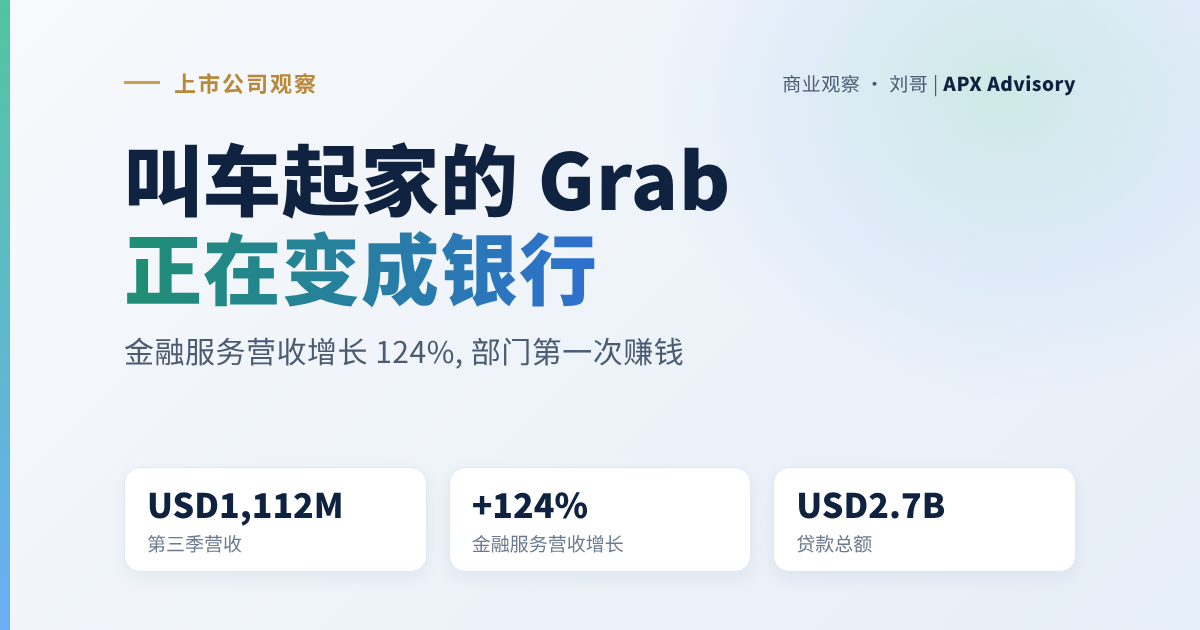
Grab began in Malaysia in 2012 as MyTeksi. In Q3 2026, revenue reached USD1,112 Million and financial services revenue grew 124%, with the unit turning EBITDA positive for the first time. Its edge is driver and merchant data that banks cannot see.
Key takeaways
- Q3 2026 revenue was USD1,112 Million, up 27%, with 57 Million monthly users.
- Financial services revenue grew 124% to USD201 Million. The unit turned EBITDA positive for the first time, at USD12 Million.
- The loan book is USD2.7 Billion, up 200%, with a 2.6% bad loan rate. Deposits sit across GXS, GXBank and Superbank.
- Grab holds transaction data on drivers and restaurants that banks cannot get. That data is a credit assessment edge.
In 2012, Anthony Tan launched MyTeksi in Malaysia, an app to book a taxi. Fourteen years later, Grab's Q3 2026 revenue reached USD1,112 Million, up 27%, with 57 Million people using it every month. The fastest-growing business is not ride-hailing, and not food delivery. It is financial services, with revenue up 124%. The company that started in Malaysia and later moved its headquarters to Singapore is turning into a bank.
Financial services makes money for the first time
In Q3, financial services revenue was USD201 Million, and the unit's EBITDA turned positive for the first time at USD12 Million. A year ago it lost USD28 Million. The loan book stands at USD2.7 Billion, up 200%, with a bad loan rate of 2.6%. Deposits are also USD2.7 Billion, spread across GXS in Singapore, GXBank in Malaysia and Superbank in Indonesia.
The real profit engine is still ride-hailing, with segment EBITDA of USD207 Million. Because of a USD57 Million fair value loss, group net profit was only USD18 Million. Taiwan's regulator blocked Grab's acquisition of foodpanda Taiwan, so Grab will receive a USD60 Million break-up fee in Q4.
Data the banks don't have
Honestly, at first I thought Grab going into banking was just following the trend. Then it clicked. Grab knows how many trips a driver makes each week and how much he earns. It knows how many orders a restaurant sells every day. Banks can't see any of this. We used to worry about drivers taking the long way. Now Grab can work out how much that driver can borrow this month.
Many SME owners also sit on years of customer data: who buys what, how often they come back. It lives in Excel or WhatsApp, and has never been used to build a second business.
Users first, then data
Users first, then data, then profit. Do you have a group of customers you actually understand better than any bank does?
FAQ
How did Grab perform in Q3 2026?
Revenue was USD1,112 Million, up 27%, with 57 Million monthly users. Due to a USD57 Million fair value loss, group net profit was USD18 Million.
Is Grab's financial services business profitable?
Yes, at EBITDA level. Q3 financial services revenue was USD201 Million, up 124%. The unit made USD12 Million EBITDA, its first positive quarter, versus a USD28 Million loss a year earlier.
Where does Grab run digital banks?
Deposits of USD2.7 Billion are spread across GXS in Singapore, GXBank in Malaysia and Superbank in Indonesia. The loan book is also USD2.7 Billion, up 200%, with a 2.6% bad loan rate.
Why does Grab have an edge in banking?
Grab sees how often drivers work and how much they earn, and how many orders restaurants sell each day. Banks don't have this data, so Grab can judge credit risk in ways a bank cannot.
What happened to Grab's foodpanda Taiwan deal?
Taiwan's regulator blocked the acquisition. Grab will receive a USD60 Million break-up fee in Q4.
This article reflects personal views and does not constitute investment advice.
About the author
William Lien is the founder of APX Advisory, a business strategy and funding advisory firm in Malaysia. He co-founded Mystartr, an equity crowdfunding platform recognised by the Securities Commission Malaysia, where he reviewed more than 2,000 business cases and pitch decks. He is a Vistage Chair for Malaysia, with about 30 years of experience as a top executive and entrepreneur. He writes about Malaysian companies, listings and SME growth as a fellow business owner sharing what he observes.
Planning to raise funds or restructure your equity? APX Advisory works with founders on funding strategy, capital readiness and equity structure.
Talk to APX Advisory