Business Insights

Insights on Malaysian companies, listings, funding strategy and SME growth by William Lien.

Proton Gave Up 49.9%. Here Is What It Got Back

Proton Gave Up 49.9%. Here Is What It Got Back

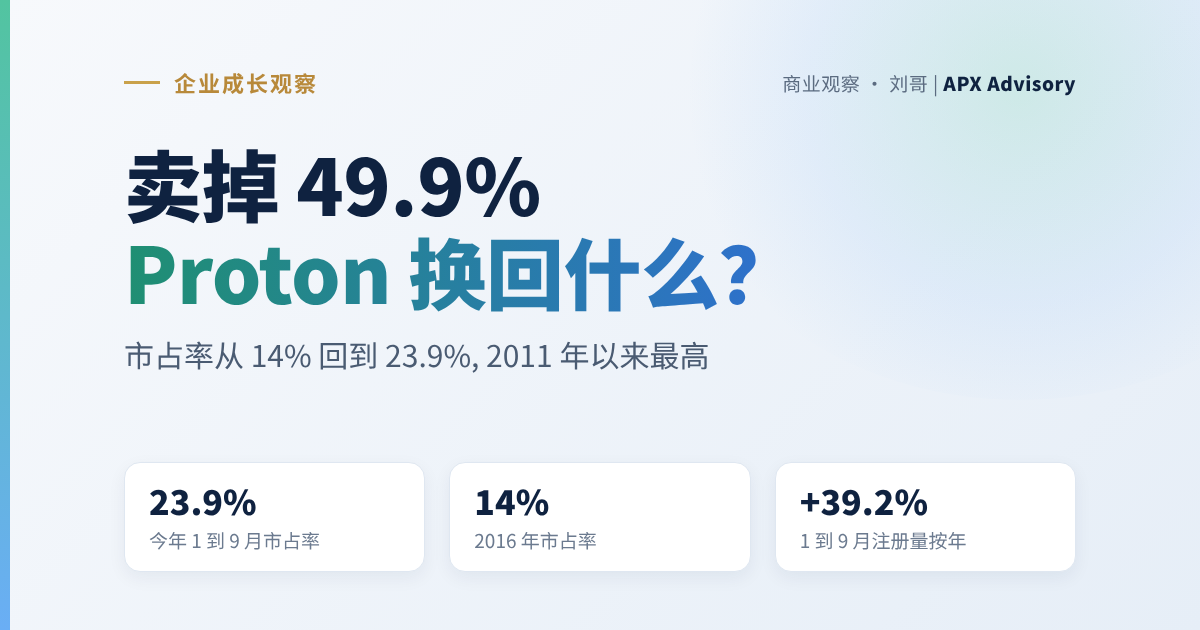
Proton's market share fell to 14% in 2016. From January to September 2026 it climbed back to 23.9%, the highest since 2011. In 2017, DRB-Hicom sold 49.9% of Proton to Geely for about RM460.3 Million. Letting go of half is not always losing. Who you give it to matters more than how much.

William Lien | Founder, APX Advisory | Co-Founder, Mystartr ·

Key takeaways

  • Proton's market share went from 14% in 2016 back to 23.9% from January to September 2026, the highest since 2011. Perodua slipped from 41.5% to 38.6% over the same period.
  • In 2017, DRB-Hicom sold 49.9% of Proton to Geely for about RM460.3 Million, along with 51% of Lotus.
  • Based on JPJ registration data, Proton registered 153,318 cars from January to September, up 39.2% year on year, while Perodua fell 3.0%.
  • For SMEs: letting go of half is not always losing, but who you give it to matters more than how much.

Proton is Malaysia's first national car brand, and Perodua, the other national brand, has long been the market leader. In 2016, Proton's market share in Malaysia had shrunk to just 14%. From January to September 2026, it came back to 23.9%, the highest since 2011. Over the same period, Perodua fell from 41.5% to 38.6%.

Ten years ago many people thought the national car was just a name. Now it is the big brother who needs to check the rear view mirror.

From 74% down to 14%

Proton was founded in 1983 as the start of Malaysia's national car project. Its market share hit 74% in 1993 and was still 53% in 2001. Then it slid all the way down. In April 2016, the government provided RM1.5 Billion in support, on the condition that Proton find a foreign strategic partner.

Back then, friends used to joke that the most important accessory when buying a Proton was the phone number of a workshop owner you trust. Fewer people tell that joke today.

What 49.9% bought

In 2017, parent company DRB-Hicom sold 49.9% of Proton to China's Geely for about RM460.3 Million, and 51% of Lotus went along with it. Honestly, at the time I was not sure whether this was a rescue or a sell out, and there was plenty of criticism online.

But Geely brought in more than money. It brought ready made car platforms, factory management and the rhythm of launching new models. The X50, X70 and S70 are all built on designs that Geely had already battle tested in the Chinese market.

The numbers are the most honest

In October this year, Proton sold 21,624 cars, bringing January to October sales to 182,510. It has a chance to pass 200,000 cars in a year for the first time since 2002. Based on JPJ registration data, from January to September Proton registered 153,318 cars, up 39.2% year on year. Perodua registered 247,397, down 3.0%. Its electric vehicle brand e.MAS sold 35,730 cars this year, and exports hit a record 2,610 cars in October.

What SME owners can learn

The logic is that Proton did not crawl its way back alone. It traded half its shares for a partner who had already made many of the mistakes. Many SME owners would rather own 100% of a company that slowly shrinks than give 30% or 49% to someone who brings technology and markets.

Put it this way. 100% of RM10 Million, or 50.1% of RM100 Million, which is worth more? Proton took 9 years to answer that.

That said, Perodua is still number one. Its 38.6% share is well ahead, and the Bezza registered 73,476 cars from January to September, still more than the Saga's 68,038. Proton exports fewer than 10,000 cars a year, so it is still a long way from truly going global. Proton is back. Whether it can take the top spot, I am still watching.

Letting go of half is not always losing. But who you give it to matters more than how much. Does your company have a partner worth sharing equity with?

FAQ

What is Proton's market share now?

From January to September 2026, Proton's market share in Malaysia was 23.9%, the highest since 2011. In 2016 it was only 14%. Over the same period, Perodua's share fell from 41.5% to 38.6%.

When did Geely buy into Proton?

In 2017, parent company DRB-Hicom sold 49.9% of Proton to China's Geely for about RM460.3 Million. A 51% stake in Lotus was sold to Geely at the same time.

What did Geely bring to Proton?

Geely brought ready made car platforms, factory management and a faster rhythm of launching new models, not just money. The X50, X70 and S70 are based on designs Geely had already proven in China.

How many cars has Proton sold this year?

Proton sold 21,624 cars in October and 182,510 from January to October, with a chance to pass 200,000 in a year for the first time since 2002. Based on JPJ registration data, it registered 153,318 cars from January to September, up 39.2% year on year.

Has Proton overtaken Perodua?

Not yet. Perodua is still number one with a 38.6% share, and the Bezza registered 73,476 cars from January to September, more than the Saga's 68,038.

What can SME owners learn from Proton?

Proton traded half its equity for a partner who had already learned many hard lessons. Owning 100% of a shrinking company is not necessarily worth more than owning 50.1% of a much bigger one. Letting go of half is not always losing, but who you choose matters more than how much you give.

This article reflects personal views and does not constitute investment advice.
TSMC Is Up 59.7%. Is Malaysia's Electronics Sector Keeping Up?

TSMC Is Up 59.7%. Is Malaysia's Electronics Sector Keeping Up?

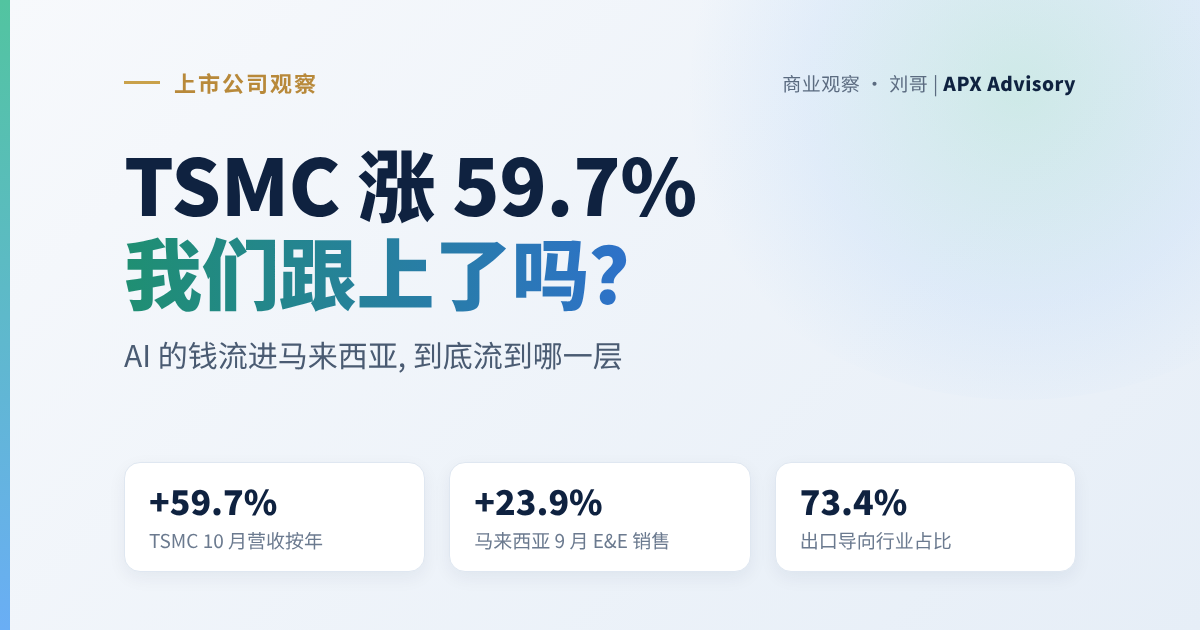
TSMC's October revenue rose 59.7% year on year to NT$586.89 Billion. In September, Malaysia's E&E manufacturing sales grew 23.9%. The AI wave has reached Malaysia, but the gap between those two numbers is the gap in value added. The further forward you stand in the supply chain, the bigger your share.

William Lien | Founder, APX Advisory | Co-Founder, Mystartr ·

Key takeaways

  • TSMC's October revenue was NT$586.89 Billion, up 59.7% year on year and 14.7% from September. January to October revenue totalled NT$4,485.62 Billion, up 43.3%.
  • Malaysia's September manufacturing sales of E&E products rose 23.9%, with computer, electronic and optical products up 26.6%.
  • Malaysia's September manufacturing sales were RM191.1 Billion, with export oriented industries making up 73.4%.
  • The gap between the two growth numbers reflects the gap in value added along the supply chain.

TSMC's October revenue was NT$586.89 Billion, up 59.7% from the same month last year and 14.7% from September. Over the same period, Malaysia's manufacturing sales of E&E, meaning electrical and electronics, products rose 23.9% in September. One is the source of AI chips. The other is our factories. Put the two numbers side by side and the gap is easy to see.

The source of AI chips, and our factories

TSMC was founded in Taiwan in 1987 by Morris Chang, and today NVIDIA's AI chips are mainly manufactured by TSMC. Its revenue from January to October totalled NT$4,485.62 Billion, up 43.3%.

On our side, September manufacturing sales were RM191.1 Billion, and export oriented industries accounted for 73.4%. Computer, electronic and optical products rose 26.6%. The AI wave has definitely reached Malaysia.

Which layer does the AI money reach in Malaysia?

Honestly, I keep asking myself where exactly the AI money lands when it flows into Malaysia. The most advanced chips are made in Taiwan. Factories in Penang and Kulim, Malaysia's main electronics hubs in the north, handle packaging, testing and components, and they get a slice too.

But TSMC is up 59.7% and our E&E is up 23.9%. That gap in between is the gap in value added. The further forward you stand, the more you take home.

Supply chain positions will be settled in a few years

The AI boom will not wait for anyone. Positions in the supply chain will be locked in within a few years. Where does your company stand on this chain, or are you just watching from the side?

FAQ

What was TSMC's October revenue?

TSMC's October revenue was NT$586.89 Billion, up 59.7% year on year and 14.7% from September. Revenue from January to October totalled NT$4,485.62 Billion, up 43.3%.

How much did Malaysia's E&E sales grow?

Malaysia's manufacturing sales of E&E products rose 23.9% in September, with computer, electronic and optical products up 26.6%. Total manufacturing sales for September were RM191.1 Billion, and export oriented industries made up 73.4%.

What is the relationship between TSMC and NVIDIA?

TSMC was founded by Morris Chang in Taiwan in 1987. Today NVIDIA relies mainly on TSMC to manufacture its AI chips.

What does Malaysia do in the AI chip supply chain?

The most advanced chips are made in Taiwan, while factories in Penang and Kulim handle packaging, testing and components. Malaysia does benefit, but the further forward a company sits in the chain, the more value it captures.

Can TSMC's numbers be compared directly with Malaysia's E&E figures?

Not exactly. TSMC's 59.7% is one company's year on year revenue growth for October, while Malaysia's 23.9% is industry wide sales growth for September. Putting them side by side shows the direction: who is capturing more of the AI boom.

This article reflects personal views and does not constitute investment advice.
A Physics Graduate Who Never Sold Anything Built 1,584 MR DIY Stores

A Physics Graduate Who Never Sold Anything Built 1,584 MR DIY Stores

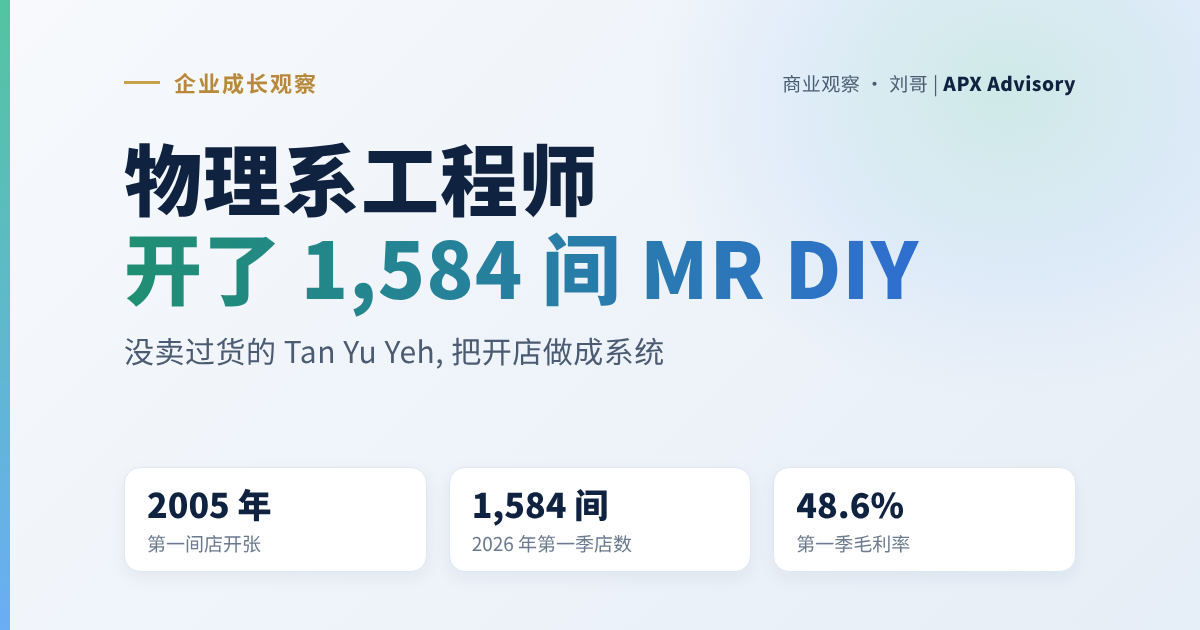
MR DIY founder Tan Yu Yeh studied physics and worked as a hard disk engineer, with no retail background. He opened the first store in Kuala Lumpur in 2005. By Q1 2026, MR DIY had 1,584 stores and RM192 Million in quarterly net profit.

William Lien | Founder, APX Advisory | Co-Founder, Mystartr ·

Key takeaways

  • Tan Yu Yeh graduated in physics from Universiti Malaya in 1996 and worked as an engineer at Komag. No retail experience at all.
  • He opened the first MR DIY in July 2005. By Q1 2026, store count grew from 1,471 a year earlier to 1,584.
  • Q1 revenue was about RM1.37 Billion, net profit RM192 Million, gross margin 48.6%.
  • An engineer looks at retail as a system that can be copied: location, shelving, logistics and restocking can all be calculated.

If you have been to any Malaysian mall, you have probably walked past an MR DIY. The chain sells the small things every household needs: screws, glue, slippers, storage boxes.

What surprised me is who started it. In 1996, Tan Yu Yeh graduated in physics from Universiti Malaya and went on to work as an engineer at hard disk maker Komag. No retail background. In July 2005, he opened the first MR DIY on Jalan Tuanku Abdul Rahman in Kuala Lumpur. By Q1 2026, MR DIY had 1,584 stores, up from 1,471 a year earlier, with quarterly revenue of about RM1.37 Billion and net profit of RM192 Million.

How one store became more than a thousand

In the first year, MR DIY reached 3 stores. It only entered its first mall, AEON Taman Equine, in 2009. It hit store number 500 in 2019. During the pandemic lockdown every store was shut, and after reopening it opened 33 stores in September 2020 alone.

His younger brother Tan Yu Wei joined in 2011 to run logistics and purchasing. After the company took logistics in-house, logistics cost reportedly fell from about 5% of revenue to around 1%. A physics graduate selling screws. Maybe he just applied Newton's first law to business: once the stores start moving, they don't stop.

Not knowing the industry meant fewer limits

Honestly, when I first learned he studied physics, I was a bit stunned. Then it made sense. An engineer doesn't see one store. He sees a system that can be copied. Location, shelving, logistics, restocking, everything can be calculated. And what he sells are things people need every day, so customers walk in without thinking twice. Gross margin in Q1 was still 48.6%.

In April 2025, he stepped down as Executive Vice Chairman to become an adviser, and handed the company to CEO Adrian Ong. Even the handover looks like system design.

Is experience a starting point, or a burden?

Experience can save you from wrong turns. It can also make you see only the roads others have already walked. Many people say you need experience before starting a business. What do you think: is experience a starting point, or a burden?

FAQ

Who founded MR DIY?

Tan Yu Yeh. He graduated in physics from Universiti Malaya in 1996 and worked as an engineer at hard disk company Komag, with no retail background. He opened the first MR DIY on Jalan Tuanku Abdul Rahman, Kuala Lumpur, in July 2005.

How many stores does MR DIY have now?

As of Q1 2026, 1,584 stores, up from 1,471 a year earlier. Quarterly revenue was about RM1.37 Billion and net profit RM192 Million.

How did MR DIY expand?

It reached 3 stores in the first year, entered its first mall (AEON Taman Equine) in 2009 and opened its 500th store in 2019. After the pandemic lockdown, it opened 33 stores in September 2020 alone.

How did MR DIY cut logistics costs?

Tan Yu Wei, the founder's younger brother, joined in 2011 to run logistics and purchasing. After logistics was brought in-house, cost reportedly dropped from about 5% of revenue to around 1%.

Does Tan Yu Yeh still run MR DIY?

In April 2025, he stepped down as Executive Vice Chairman to become an adviser. The company is now led by CEO Adrian Ong.

This article reflects personal views and does not constitute investment advice.
Grab Started With Taxis. Why Is It Turning Into a Bank?

Grab Started With Taxis. Why Is It Turning Into a Bank?

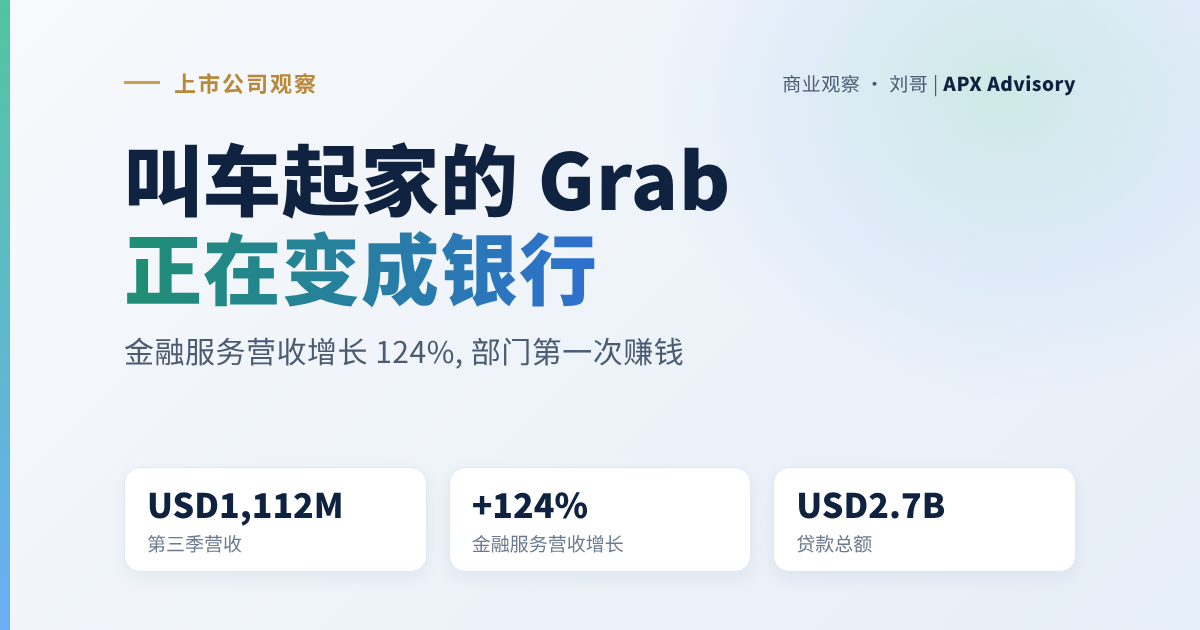
Grab began in Malaysia in 2012 as MyTeksi. In Q3 2026, revenue reached USD1,112 Million and financial services revenue grew 124%, with the unit turning EBITDA positive for the first time. Its edge is driver and merchant data that banks cannot see.

William Lien | Founder, APX Advisory | Co-Founder, Mystartr ·

Key takeaways

  • Q3 2026 revenue was USD1,112 Million, up 27%, with 57 Million monthly users.
  • Financial services revenue grew 124% to USD201 Million. The unit turned EBITDA positive for the first time, at USD12 Million.
  • The loan book is USD2.7 Billion, up 200%, with a 2.6% bad loan rate. Deposits sit across GXS, GXBank and Superbank.
  • Grab holds transaction data on drivers and restaurants that banks cannot get. That data is a credit assessment edge.

In 2012, Anthony Tan launched MyTeksi in Malaysia, an app to book a taxi. Fourteen years later, Grab's Q3 2026 revenue reached USD1,112 Million, up 27%, with 57 Million people using it every month. The fastest-growing business is not ride-hailing, and not food delivery. It is financial services, with revenue up 124%. The company that started in Malaysia and later moved its headquarters to Singapore is turning into a bank.

Financial services makes money for the first time

In Q3, financial services revenue was USD201 Million, and the unit's EBITDA turned positive for the first time at USD12 Million. A year ago it lost USD28 Million. The loan book stands at USD2.7 Billion, up 200%, with a bad loan rate of 2.6%. Deposits are also USD2.7 Billion, spread across GXS in Singapore, GXBank in Malaysia and Superbank in Indonesia.

The real profit engine is still ride-hailing, with segment EBITDA of USD207 Million. Because of a USD57 Million fair value loss, group net profit was only USD18 Million. Taiwan's regulator blocked Grab's acquisition of foodpanda Taiwan, so Grab will receive a USD60 Million break-up fee in Q4.

Data the banks don't have

Honestly, at first I thought Grab going into banking was just following the trend. Then it clicked. Grab knows how many trips a driver makes each week and how much he earns. It knows how many orders a restaurant sells every day. Banks can't see any of this. We used to worry about drivers taking the long way. Now Grab can work out how much that driver can borrow this month.

Many SME owners also sit on years of customer data: who buys what, how often they come back. It lives in Excel or WhatsApp, and has never been used to build a second business.

Users first, then data

Users first, then data, then profit. Do you have a group of customers you actually understand better than any bank does?

FAQ

How did Grab perform in Q3 2026?

Revenue was USD1,112 Million, up 27%, with 57 Million monthly users. Due to a USD57 Million fair value loss, group net profit was USD18 Million.

Is Grab's financial services business profitable?

Yes, at EBITDA level. Q3 financial services revenue was USD201 Million, up 124%. The unit made USD12 Million EBITDA, its first positive quarter, versus a USD28 Million loss a year earlier.

Where does Grab run digital banks?

Deposits of USD2.7 Billion are spread across GXS in Singapore, GXBank in Malaysia and Superbank in Indonesia. The loan book is also USD2.7 Billion, up 200%, with a 2.6% bad loan rate.

Why does Grab have an edge in banking?

Grab sees how often drivers work and how much they earn, and how many orders restaurants sell each day. Banks don't have this data, so Grab can judge credit risk in ways a bank cannot.

What happened to Grab's foodpanda Taiwan deal?

Taiwan's regulator blocked the acquisition. Grab will receive a USD60 Million break-up fee in Q4.

This article reflects personal views and does not constitute investment advice.